Home › Services › Brand Guidelines

Brand Guidelines: How to Build a Visual Identity System That Scales

A brand without guidelines is a brand without control. Every time a designer interprets your logo slightly differently, every time a social media post uses the wrong shade of blue, every time a presentation slides into an off-brand font — your identity erodes. Brand guidelines are the document that prevents this erosion. They codify every visual and verbal decision into a single, authoritative reference that anyone working with your brand can follow.

At bf agency, a brand identity studio based in Tallinn, Estonia, we design brand guidelines that are not just comprehensive but usable. A 200-page PDF that nobody reads is no better than having no guidelines at all. Our approach balances thoroughness with clarity, creating documents that teams actually open, reference, and follow. This page explains what brand guidelines include, why they matter, and how we create them.

What Brand Guidelines Are and Why They Matter

Brand guidelines — also called a brand book, brand manual, or visual identity standards — are a set of rules that define how a brand should be presented across all media and touchpoints. They cover visual elements like logo usage, colour palettes, and typography, as well as verbal elements like tone of voice and messaging frameworks.

The purpose is consistency. Consistency builds recognition. Recognition builds trust. Trust drives business. Research consistently shows that brands presented consistently across platforms see significant increases in revenue. The logic is straightforward: when people encounter the same visual language repeatedly, they begin to recognise and trust the brand. When the visual language shifts unpredictably, that trust never forms.

Brand guidelines matter most when multiple people touch the brand. The moment you hire a second designer, engage a marketing agency, brief a printer, or onboard a new team member, you need a single source of truth. Without it, every person makes their own interpretation — and the brand fragments.

What We Include in Brand Guidelines

Every brand is different, and the scope of guidelines should reflect the brand's complexity and scale. However, most professional brand guidelines we create at bf agency cover the following core sections:

Logo Usage

This is the most critical section. It defines every acceptable version of the logo — full colour, monochrome, reversed, horizontal, stacked — and specifies exactly when and where each version should be used. We define clear space requirements (the minimum empty area around the logo), minimum reproduction sizes for print and digital, and placement rules for different contexts. Equally important, we document what not to do: no stretching, no rotating, no colour modifications, no low-resolution reproduction. These "misuse" examples are often the most referenced section in any brand book because they prevent the most common mistakes.

Colour Palette

Colour is the most immediately recognisable element of any brand. Our guidelines specify primary and secondary colour palettes with exact values across colour systems: HEX and RGB for digital, CMYK for print, Pantone for spot colour applications. We define colour ratios — typically 60-30-10 proportions — so designers know which colours dominate and which are accents. We also include accessibility notes, specifying which colour combinations meet WCAG contrast standards for text and backgrounds.

Typography

Typography guidelines define the typefaces used across all brand communications. We specify primary and secondary fonts, including weights, sizes, and line heights for headings, body text, captions, and UI elements. For digital brands, we include web font specifications and fallback stacks. For brands that use custom or licensed typefaces, we provide licensing information and free alternatives for situations where the primary fonts are unavailable — such as internal documents or email templates.

Graphic Elements and Patterns

Beyond the logo, most brand identities include supporting graphic elements: geometric patterns, texture overlays, illustration styles, iconography systems, or photographic treatments. Our guidelines define how these elements should be used, at what scale, and in what contexts. We provide source files and clear instructions for creating new elements that stay within the system.

Photography and Imagery Direction

For brands that use photography heavily — particularly in marketing, social media, and websites — we define the photographic style in detail. This includes lighting preferences (natural vs. studio), colour grading or filter specifications, composition guidelines, subject matter direction, and mood references. We provide reference boards and example images that capture the intended aesthetic, making it easy for photographers and content creators to shoot on-brand imagery without a lengthy brief each time.

Layout and Grid Systems

How elements are arranged on a page or screen is just as important as the elements themselves. Our guidelines include grid systems for common formats: A4 and US Letter documents, social media templates, presentation slides, and web page layouts. We define margins, column structures, and spacing rules that create visual consistency across all formats.

Tone of Voice

Visual identity is only half the equation. How a brand speaks is equally important. Our verbal guidelines define the brand's tone of voice through specific attributes (e.g., confident but not arrogant, warm but not casual), provide before-and-after examples of on-brand and off-brand writing, and establish rules for common communications like email signatures, social media captions, and website copy.

Digital Specifications

Modern brands live primarily in digital contexts. Our guidelines include specifications for web and app implementations: CSS custom properties for colours and fonts, component spacing tokens, favicon and app icon specifications, social media profile and cover image templates, and email signature HTML. These technical specifications bridge the gap between design intent and development execution.

The Difference Between Basic and Comprehensive Guidelines

Not every brand needs a 100-page manual. The appropriate level of detail depends on the brand's scale, the number of people who work with it, and the diversity of its touchpoints.

Brand Sheet (Essential)

A single-page or two-page document covering logo versions, primary colours, and typography. Suitable for solopreneurs and very small businesses with minimal touchpoints. Cost: typically included with a logo design project or available as a standalone deliverable from 500 EUR.

Brand Guidelines (Standard)

A 15 to 30-page document covering all core sections: logo, colour, typography, graphic elements, basic photography direction, and key application examples. Suitable for SMEs and startups working with external partners. Cost: 2,000 to 4,000 EUR as part of a brand identity project.

Comprehensive Brand Book

A 40 to 80+ page document with full specifications across all categories, including tone of voice, detailed digital specifications, template files, and application examples across every touchpoint. Suitable for companies with large teams, multiple departments, or franchise operations. Cost: 4,000 to 6,000+ EUR depending on scope.

Our Process for Creating Brand Guidelines

Brand guidelines are typically created as the final deliverable of a brand identity project. However, we also create guidelines for existing identities that lack documentation. Here is our process:

Phase 1: Audit and Inventory

We begin by cataloguing every existing brand element: logo files, colours in use, fonts across platforms, marketing materials, social media profiles, signage, packaging, and digital products. This audit reveals inconsistencies and gaps. For new identities, this phase happens during the brand identity design process itself.

Phase 2: System Definition

Based on the audit, we define the rules. Which logo versions are needed? What is the complete colour system? Which typographic hierarchy works across all required formats? What graphic elements support the identity? This phase involves close collaboration with the client to ensure the guidelines reflect real-world needs, not theoretical ideals.

Phase 3: Documentation and Design

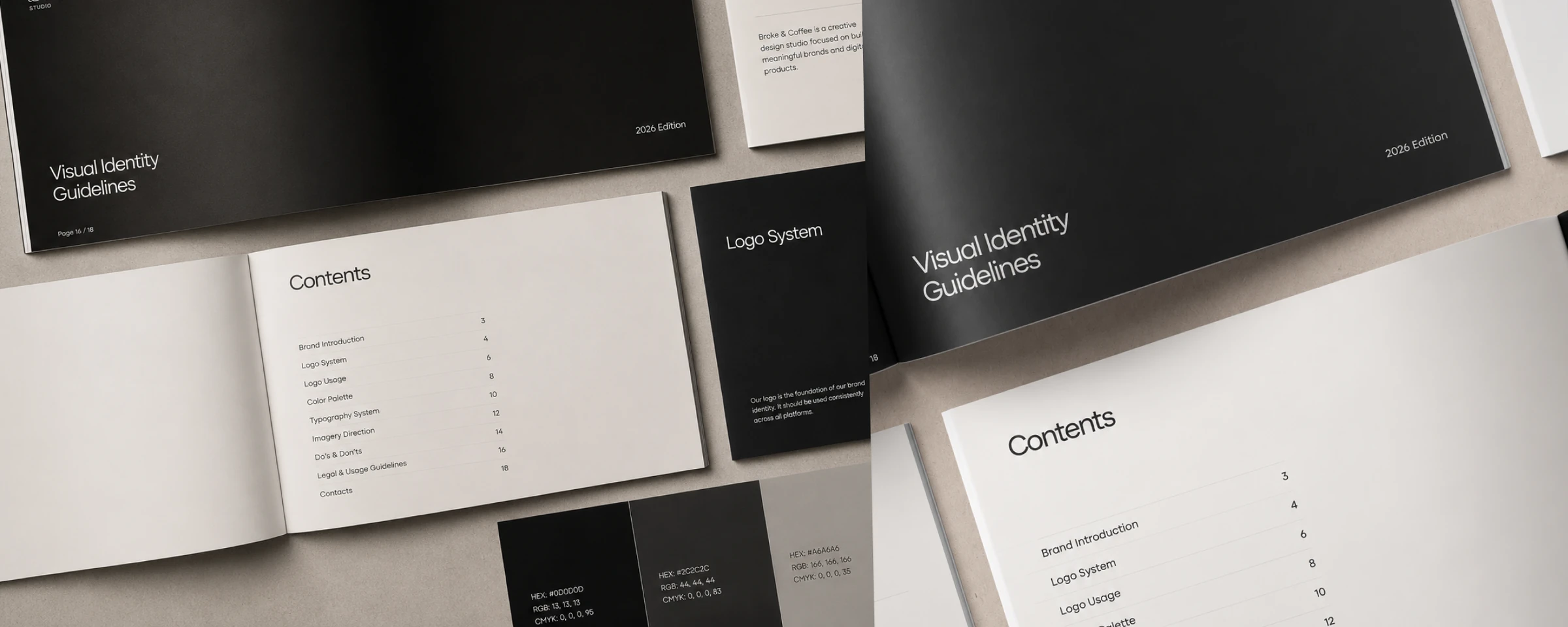
We write and design the guidelines document itself. This is a design project in its own right — the brand book should itself be a showcase of the brand identity. We use the brand's own fonts, colours, and layout principles throughout the document, demonstrating proper application on every page. Each rule is accompanied by clear visual examples showing correct and incorrect usage.

Phase 4: Testing and Refinement

Before delivery, we test the guidelines by applying them to real scenarios: creating a social media post using only the guide, designing a business card, building a web page section. If any rule is ambiguous or any specification is missing, we catch it at this stage. We also share the draft with the client's team for feedback, ensuring the document addresses their actual workflow.

Phase 5: Delivery and Handover

The final guidelines are delivered as a designed PDF, optimised for both screen viewing and printing. We also provide all source files — logo vectors, colour swatches for Adobe and Figma, font files or links, and any template files referenced in the guide. For digital-first brands, we can deliver a web-based version or Notion template that is easy to update and share.

Brand Guidelines for Digital-First Brands

Traditional brand guidelines were designed for print-centric workflows. Today, most brand applications are digital: websites, apps, social media, email, and digital advertising. Digital-first brand guidelines need to account for responsive design, dark mode, animation, interaction states, and component-based development.

At bf agency, we create guidelines that bridge design and development. Our digital brand specifications include design tokens — named values for colours, spacing, typography, and shadows that can be directly translated into CSS custom properties or design tool libraries. This means the same source of truth drives both the Figma design system and the production CSS, eliminating drift between design and code.

We also address responsive behaviour: how the logo adapts at different viewport sizes, how typography scales between mobile and desktop, and how layout grids transform across breakpoints. These specifications are increasingly important as brands operate across an ever-growing number of screen sizes and formats.

Why Brand Guidelines Fail and How to Prevent It

The most common reason brand guidelines fail is not poor content — it is poor adoption. A beautifully designed brand book that sits in a shared drive folder, unopened, serves no purpose. Here are the key factors that determine whether guidelines actually get used:

Brand Guidelines in Tallinn and Estonia

Estonia's business ecosystem is uniquely digital-forward. The country's e-residency programme, startup culture, and technology sector mean that many brands here operate across borders from day one. Brand guidelines for Estonian companies need to account for multilingual applications (Estonian, English, and often Russian), cross-cultural visual communication, and digital-first touchpoints.

At bf agency, we serve clients across Estonia and the European Union, creating brand guidelines that work across languages and cultures. Whether you are a Tallinn-based startup preparing for international expansion or an established Estonian company formalising a brand identity that has grown organically, our process adapts to your context while maintaining the highest standards of visual and strategic rigour.

Frequently Asked Questions

What are brand guidelines?

Brand guidelines are a comprehensive document that defines how a brand should be presented visually and verbally across all touchpoints. They include rules for logo usage, colour palettes, typography, imagery, tone of voice, and layout principles to ensure consistency.

How much do brand guidelines cost?

Brand guidelines typically cost between 2,000 and 6,000 euros depending on scope. A basic brand sheet covering logo, colours, and typography starts around 500 EUR as a standalone deliverable. A standard 20-30 page guide runs 2,000 to 4,000 EUR. A comprehensive brand book with full specifications, templates, and digital tokens costs 4,000 to 6,000+ EUR.

What is the difference between brand guidelines and a brand book?

The terms are often used interchangeably. A brand book tends to be a more visual, narrative document that tells the story of the brand, while brand guidelines focus on practical rules and specifications. At bf agency, we combine both approaches — storytelling and precision — into a single comprehensive document.

How long does it take to create brand guidelines?

Creating brand guidelines typically takes 3 to 6 weeks after the brand identity design is complete. A basic guide can be completed in 2 to 3 weeks. A comprehensive multi-format guide with digital specifications and templates may require 4 to 6 weeks.

Do I need brand guidelines for a small business?

Yes. Even small businesses benefit from brand guidelines. A concise brand sheet covering logo usage, colours, and fonts prevents inconsistency as your team grows and you work with external designers, printers, or marketing agencies. The investment is minimal compared to the cost of correcting brand inconsistencies later.

What format are brand guidelines delivered in?

We deliver brand guidelines as a designed PDF document optimised for both screen viewing and printing. For digital-first brands, we also provide a web-based version or Notion template. All source files — logo vectors, colour swatches, font files, and templates — are included in the delivery.

Ready to create brand guidelines that your team will actually use?

Start a Project →   or   Fill Out a Brief →